


Water Conservation
How Farmers and Craft Brewers Keep Rivers Flowing
- Sinagua Malt works with local farmers to shift from a traditional summer crop, such as corn or alfalfa, to a late winter/spring crop, such as malt barley. This shift to a crop that provides equivalent revenue at a different time of year results in less irrigation water diverted from the river during the high-demand, low streamflow summer period. The result is more water in rivers for people and wildlife, and a profitable crop for local farmers.
- Sinagua Malt purchases the raw barley, processes it, and sells the resulting malt, the base ingredient in beer, to craft brewers.
- Craft brewers who value local farm products and flowing rivers produce quality beer.
- Beer drinkers quaff delicious beer, knowing that they are supporting local farmers and flowing rivers, a great combination!
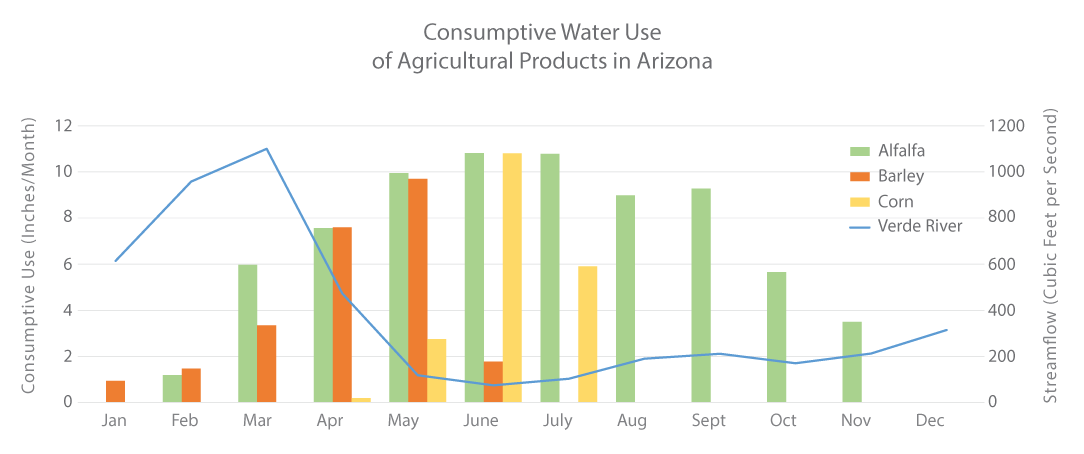
Crop Consumptive Use is the amount of water taken from the system to produce a crop. Barley and corn have similar consumptive uses but a different growing season in the arid Southwest. The mean monthly streamflow in the Verde River compared to crop consumptive use demonstrates that corn needs water most when it is least available.
The Math Behind the Savings
Every acre a farmer converts from a traditional summer crop to malt barley makes a measurable difference. Here’s the calculation, using Arizona-specific water-use data from University of Arizona Cooperative Extension research:
- Alfalfa in Arizona uses about 5.7 acre-feet of water per acre per year — among the thirstiest crops grown in the state.
- Barley uses about 2.5 acre-feet of water per acre — roughly half as much.
- That’s a difference of 3.2 acre-feet per acre, or about 1,042,700 gallons of water saved for every acre converted from alfalfa to barley (1 acre-foot = 325,851 gallons).
- Corn (silage corn, the type most commonly grown in the Verde Valley) uses a broadly similar total volume of water to barley over a full year — but nearly all of it falls in the hot summer months, exactly when the Verde River is under the most stress. Barley’s water use falls almost entirely in winter and spring instead. So the benefit of a corn-to-barley switch isn’t primarily about using less water overall — it’s about removing that demand from the river during the critical low-flow season.
What this means at full malting capacity
After the malthouse expansion in 2024, Sinagua Malt’s malthouse can process up to 30 tons of barley per week at full capacity — about 1,560 tons a year. Based on recent yields (roughly 2.8 tons of barley per acre), that’s enough capacity to use barley from about 560 acres.
At that scale, fully replacing alfalfa on 560 acres with barley would keep approximately:
580 million gallons of water per year in the Verde River — at full malting capacity.
That number is a target, not a guarantee. Sinagua Malt only processes as much barley as its brewery, distillery, and homebrew customers actually buy. Every additional order is what allows another acre of thirsty summer crops to be converted to barley in the first place — more customers means more barley purchased, more farmland converted, and more water kept in the river. Order Sinagua Malt for your brewery to be part of that math directly.
A Growing Partnership
Sinagua Malt was founded in 2016 by Chip Norton and Steve Ayers, working in partnership with The Nature Conservancy’s Verde River program. Before the exapansion, data from The Nature Conservancy, shows the project kept 425 million gallons of water in the Verde River by 2019, growing to more than 725 million gallons saved between 2016 and 2023 as barley acreage expanded from 95 acres in 2016 to over 610 acres. The malthouse itself has scaled from processing roughly 150 tons of barley a year to over 1,700 tons. In 2023, Sergio Goma and his wife Ofelia took over Sinagua Malt, expanding Sinagua Malt processing capacity eight times to its current capacity of over 1500 tons per year.
Our Brewery Partners Drink Like They Care
Our brewery partners don’t just buy Arizona-grown malt — several have built entire campaigns around what that malt represents. Arizona Wilderness Brewing Co., one of Sinagua Malt’s founding customers, uses 100% Sinagua Malt as the base for every beer it brews, as part of its “Drink Like You Care” sustainability campaign. The brewery has calculated that its use of Sinagua Malt saved roughly 66.5 million gallons of Verde River water in 2024 alone, and estimates that each pint of Arizona Wilderness beer consumed saves close to 90 gallons of water. Their IPA, aptly named This Beer Saves Water, is brewed with 100% Sinagua Malt alongside drought-resistant hop varieties, driving the water-conservation message home from grain to glass.
In Their Words
Press Coverage
- “How Two Committed Conservationists Revitalized a River With Beer” — Modern Farmer, March 2024.
- “Sinagua Malt Grows Collaboration (and a Barley Economy) in the Verde Valley” — Arizona State University Sustainable Food Systems program, February 2024.
- “Arizona’s First Malt House Saves Water for Farmers, Supports Local Breweries” — Cronkite News / Arizona PBS, September 2018.
- “How Beer Will Save Western Rivers” — Outside, on The Nature Conservancy’s broader river-conservation work with Sinagua Malt.
Sources for our water-use calculations
- “Developing Sustainability Metrics for Water Use in Arizona Small Grain Production” — University of Arizona Cooperative Extension
- “Silage Corn Yield, Water Productivity, and Quality Under Different Irrigation Scenarios in Arizona” — University of Arizona Cooperative Extension
- Arizona alfalfa water-use figure from Lower Colorado River Basin reporting, via This Is Tucson / Arizona Daily Star
Want to help keep the Verde flowing? Order Sinagua Malt for your brewery, or read our full story to see how it all started.